Galbot (Galaxy General)
Galbot is the Beijing startup building a wheeled humanoid (the Galbot G1) paired with its own Vision-Language-Action foundation models, betting that wheeled mobility reaches commercial utility faster than bipedal walking.
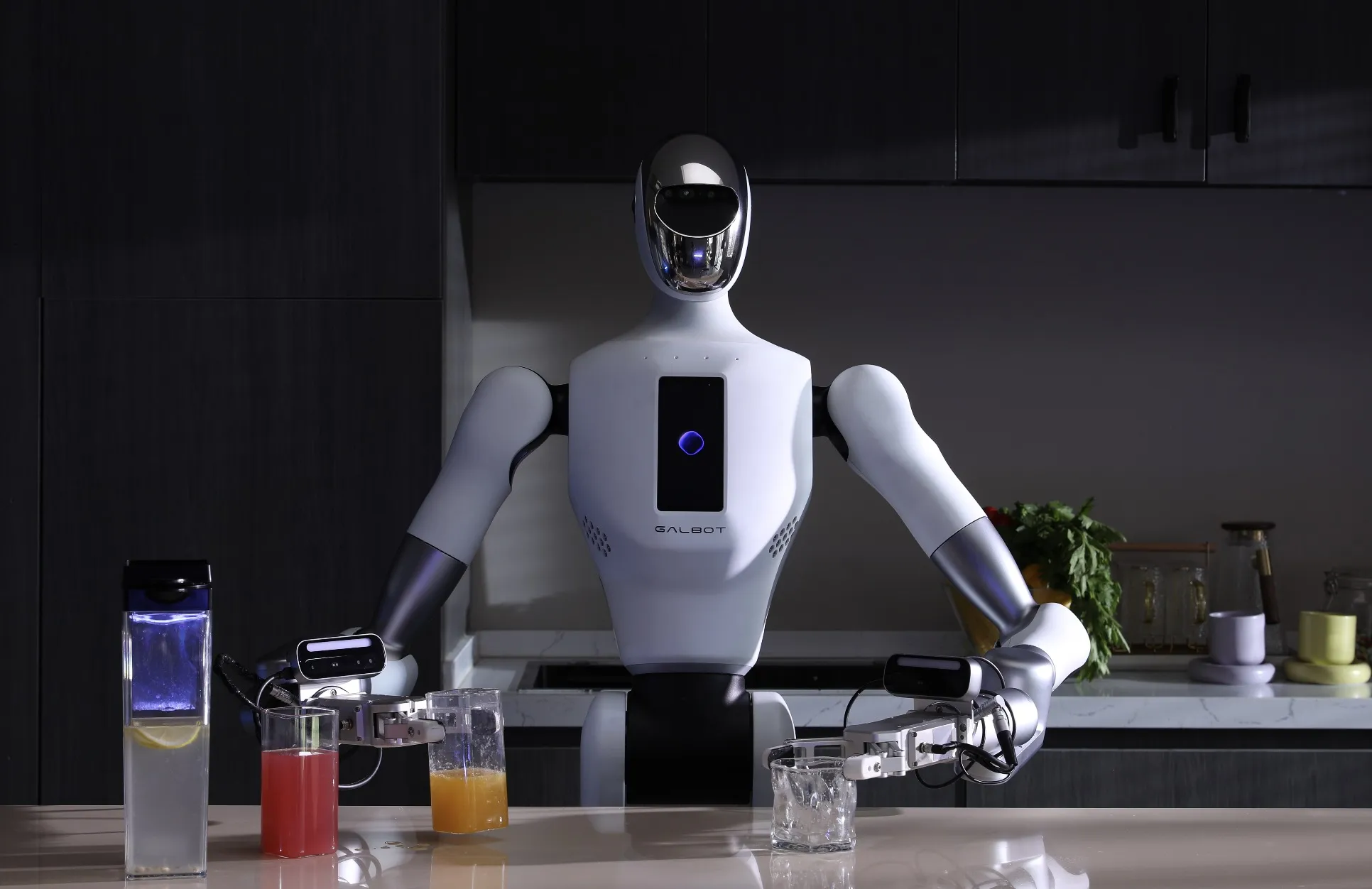
Company Overview
- Galbot is among the most prominent embodied-AI startups in China, founded in 2023 by researchers from top AI labs.
- Its core bet: instead of chasing perfect bipedal walking, deploy a wheeled humanoid with a capable torso, arms and hands, and drive it with Vision-Language-Action (VLA) foundation models trained for manipulation.
- The company has demonstrated commercial pilots in retail, logistics and service settings, positioning itself as a software-plus-hardware play rather than a pure robot maker.
Key Facts
| Full Name | Beijing Galaxy General Robotics (Galbot) |
|---|---|
| Chinese Name | 银河通用机器人 |
| Founded | 2023 |
| Headquarters | Beijing, China |
| Core Products | Galbot G1 wheeled humanoid, GraspVLA models |
| Backing | Backed by prominent VCs and strategic investors |
| Focus | Foundation models + wheeled humanoid for real-world tasks |
Data Snapshot
| Founded | May 2023, Beijing — founder Wang He (王鹤, Peking University) |
|---|---|
| Funding | ~RMB 7B across 6 rounds in 34 months; valuation >RMB 20B (~US$3B) |
| 2026 Round | B++ RMB 2.5B (Mar 2026) — National Big Fund III first embodied-AI bet; Sinopec, CITIC, BOC, SAIC, SMIC-backed fund |
| Shipments | 1,100+ units in 2026 H1 (No.3 in China; ~5% global share per IDC) |
| Flagship | Galbot G1 embodied robot — 7x24 work at CATL plants; SAIC & BAIC entry |
| Paradigm | Simulation-first training (synthetic data > real data) |
Products & Specs
| Product | Type | Status |
|---|---|---|
| Galbot G1 | Universal embodied robot | 7x24 operations at CATL; commercial scale |
| Galaxy Space capsule store | Autonomous retail | 100+ sites in 20+ cities |
| AstraBrain | VLA foundation model | Core AI stack |
Key Customers
- Industrial — CATL (tens of plants), SAIC, BAIC; thousands of unit orders
- Retail — capsule convenience stores (100+ sites)
- Healthcare & services — early deployments
Recent Milestones
- May 2023 — Founded by PKU researcher Wang He
- Jun 2024 — Galbot G1 unveiled
- Dec 2025 — B+ round >US$300M
- Mar 2026 — B++ RMB 2.5B; Big Fund III first embodied-AI investment
- 2026 H1 — 1,100+ shipments; CATL 7x24 operations
Actuators & Sensors
- Lightweight, high-DOF dual arms and dexterous hands optimized for manipulation over locomotion.
- Wheeled base for stable, energy-efficient indoor navigation.
- Depth + RGB camera rig, LiDAR, and wrist force-torque sensing.
Supply-Chain Analysis
- Galbot outsources standard actuators and reducers to domestic suppliers and focuses in-house effort on the control stack and foundation models.
- The arm joints use harmonic reducers sourced from Chinese makers including Leaderdrive and Hengtong.
- Compute runs on domestic AI accelerator boards, with a cloud-side training pipeline.
Competitor Comparison
Versus bipedal humanoids (Unitree, AgiBot, Fourier): Galbot trades legs for a wheeled base and bet on manipulation + VLA models. This gives it lower cost and faster indoor deployment, at the cost of stair/terrain mobility.
Frequently Asked Questions
What does Galbot (Galaxy General) do?
Galbot (Galaxy General) (银河通用) is a Chinese robotics company whose focus is Galbot G1 wheeled humanoid, GraspVLA models. It sits in the fast-moving Chinese humanoid and embodied-AI segment, where companies compete on joint actuation, perception and manufacturing cost.
How does Galbot (Galaxy General) compare with humanoid leaders such as Unitree, Fourier or Tesla Optimus?
China's humanoid field is crowded. Galbot (Galaxy General) is part of that ecosystem, competing against better-known names such as Unitree and Fourier and international programs like Tesla Optimus. Differentiation usually comes from Galbot G1 wheeled humanoid, GraspVLA models, plus supply-chain and cost advantages common to Chinese builders.
Where is Galbot (Galaxy General) based?
Galbot (Galaxy General) (银河通用) is headquartered in Beijing, China, China, one of the country's robot-industry clusters.