Industrial Robot Companies
Estun, Inovance and SIASUN — profiles, facts and market data.
Companies
For years, the robot arms on Chinese factory floors said ABB, FANUC, Yaskawa and KUKA. In 2025, for the first time, they said Estun, Inovance and SIASUN. Here's how the home team won.
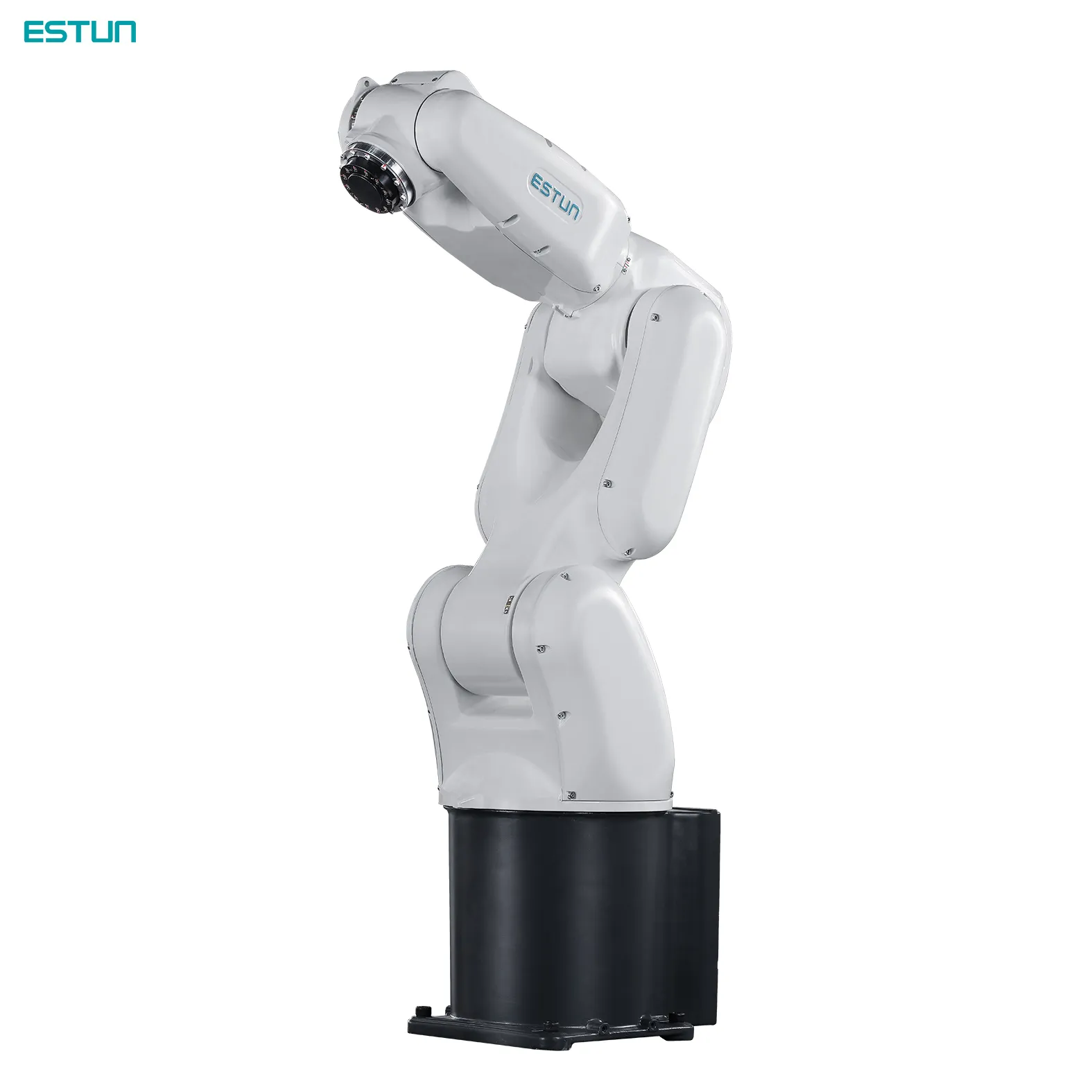
In 2025, a milestone passed with almost no fanfare outside China: domestic brands overtook foreign brands in China's industrial-robot market for the first time. The country that once bought its robot arms from the "big four" — ABB, FANUC, Yaskawa and KUKA — now builds more of them itself.
It matters more than it sounds. China has been the world's largest industrial-robot market for 11 straight years, and it buys roughly half of the world's industrial robots. Whoever wins this market shapes global factory automation.
Nanjing's Estun (埃斯顿) shipped roughly 33,400 industrial robots in 2025, about a 10.6% share — the first time a Chinese brand topped the domestic market, overtaking the foreign "big four." Estun's advantage is vertical integration: it builds more than 80% of its own content, including the servo drives and controllers that are the robot's nervous system. That gives it a cost and a response-time edge that bolt-on assemblers cannot match.
Shenzhen's Inovance (汇川技术) took a different path. It is China's largest motion-control and drive company — born out of Huawei's electrics team — and it leveraged its massive installed base of servo motors and PLCs to move up into complete robot arms. Today it holds roughly 9–12% of the domestic industrial-robot market, strongest in SCARA robots used in electronics assembly.
Shenyang's SIASUN (新松) is China's first robotics company, founded in 2000 and named after Jiang Xinsong, the "Father of Chinese Robotics." It spans industrial arms, mobile robots and, increasingly, humanoid research platforms. If Estun is the new challenger, SIASUN is the institutional memory of the industry.
Why the home team won: three forces lined up. First, the supply chain — China builds the motors, reducers and controllers locally. Second, speed — Chinese vendors iterate and customise faster than foreign incumbents. Third, demand — the EV battery and solar manufacturing boom created an army of buyers who wanted service, price and speed, not legacy brand names.
The industrial-robot takeover matters for two reasons. It gives China's robotics industry a profitable, real-revenue base to fund its more speculative bets — like humanoids. And it signals a broader shift: in factory automation, the centre of gravity has moved east. The "world's factory" no longer just buys the machines; it makes them.
Estun, Inovance and SIASUN — profiles, facts and market data.
The four-decade history behind the takeover — from 1980 to the humanoid era.
How the capital behind China's robotics boom actually flows.
Estun ↗ · SIASUN ↗ · Inovance ↗ · Mech-Mind ↗ · Topstar ↗
Estun industrial arms, Mech-Mind vision systems and more — explore the full product line-up.