Leaderdrive (Green Harmonic) — Company Profile
The full history, product lines and financials of China's No.1 harmonic reducer maker.
For half a century, every serious robot joint in the world passed through Japan: Harmonic Drive's strain wave gears held roughly 58% of global revenue, and its IH tooth profile was the industry's walled garden. Then a Suzhou company founded in 2011 rewrote the economics — and in 2025, China's Leaderdrive was No.1 in its home market, owned 80-90% of China's humanoid reducers, and became the only Chinese maker in the category profitable at scale. Here is the joint war, dimension by dimension.
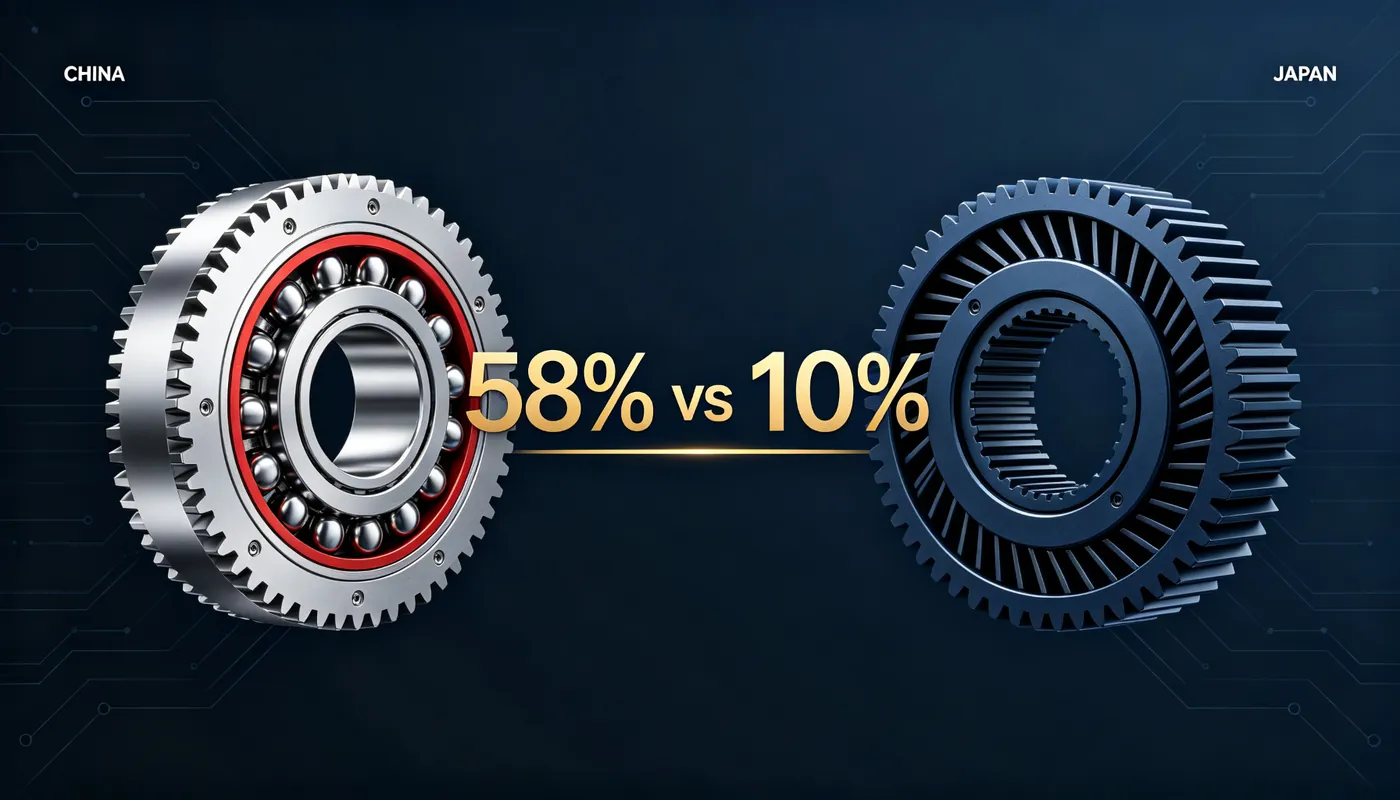
The harmonic reducer is the joint of the robot: a strain wave gear that packs high precision into a small, light package. If you have ever wondered why a Chinese humanoid robot can sell for $30,000 while an American one costs 14x more, part of the answer is sitting inside every joint. And for the first sixty years of the industry, that part was Japanese.
Harmonic Drive Systems commercialized the technology in 1964, after buying the patents of American inventor C.W. Musser, and by the 1970s its IH tooth profile was the de facto standard, holding over 90% of the global market through the 2000s. As recently as 2024 it still took 58% of global revenue (40-50% of units) and over 70% of premium segments — semiconductors, medical devices, aerospace. Then the math changed.
| Metric | Leaderdrive / Green Harmonic (China) | Harmonic Drive (Japan) |
|---|---|---|
| Global revenue share | ~10-12% (2024-25) · No.2 · only Chinese maker in global top 5 | 58% (2024) · 40-50% of units · No.1 |
| China, by units | No.1 — 27.5% (2025); Chinese makers passed foreign brands in 2025 | 36% (2024H1), down from the 61% its duo with Shinsei held in 2018 |
| China humanoid robots | 80-90% of Chinese humanoids using harmonic reducers (up from ~70%) | Tesla Optimus early prototypes; premium lock-in fading |
| 2025 revenue | RMB 571M (+47.3% YoY) | JPY 55.6B (~RMB 2.7B); reducers ~70% of sales |
| Profitability | RMB 124M net profit (+121%) — the only Chinese maker profitable at scale | Operating profit JPY 124M (FY2024) → operating loss (FY2025) |
| Average price | ~RMB 1,246/unit (2025, -5.5% YoY); 1/2-2/3 of import price | Premium ASP; high-end mix keeps prices higher |
| Lifetime | ~8,000-12,000 hrs (12,000h breakthrough with Baosteel steel) | 15,000+ hrs (special bearing steel, ≤50ppm impurities) |
| Backlash | ≤1 arcmin (self-developed Y tooth profile) | ≤0.5 arcmin (IH tooth profile, 1988 patent) |
| Batch consistency | 10-15% life variance | ≤5% variance |
| Supply chain | Tesla, Figure AI + Unitree, UBTech, AgiBot; ~half of China's humanoid reducer shipments (2025) | Tesla Optimus early gen; fighting to keep high-end |
Reading down that table, you can see the war in real time: Japan still holds the premium heights, but China owns the volume — and the volume is about to become the whole game. Here is how, dimension by dimension.
The global map has not flipped — yet. Harmonic Drive still takes 58% of global revenue (2024) and 40-50% of units; Leaderdrive is No.2 at ~10-12%, the only Chinese firm in the global top five, ahead of Japan's Shinsei (~4%) and Korea's ILJIN (~4%). In premium segments — semiconductor fabs, surgical robots, satellites — Harmonic Drive's grip is untouched at over 70%.
But the map that matters for the future is China's, and there the line has crossed. In 2018, Harmonic Drive and Shinsei together held 61% of the Chinese market. By 2024H1, Harmonic Drive was down to 36% of units and Leaderdrive had pulled within striking distance at 18%, with Tongchuan at 8%. In 2025 the combined Chinese share passed foreign brands for the first time — 53-68% depending on the measure — and Leaderdrive was No.1 domestically at 27.5% of units. Localization has a compounding effect: Chinese robot makers prefer Chinese reducers for cost and lead time, and every national champion added to the chain pulls the next one with it.
The price gap is the blunt instrument of this war. A Chinese-made harmonic reducer typically costs 1/2 to 2/3 of the imported equivalent. Leaderdrive's average selling price was about RMB 1,246 (~$175) per unit in 2025, down 5.5% from 2024 — falling even as volumes surge 72%.
For a robot buyer the math is blunt. General industrial-grade units run RMB 1,000-1,500; humanoid-grade units (lighter, smaller, customized) run RMB 1,500-3,000, with micro units for dexterous hands fetching more. A fully equipped humanoid — 14 standard + 8 micro reducers, or 22 joints — carries about RMB 52,000 (~$7,300) of harmonic reducers. At 2025 volumes of roughly 500,000 humanoid-related units a year, that is the seam China is now mining, and scale is feeding price: overseas humanoid-grade pricing is projected to fall from ~RMB 2,000 to ~RMB 900 per unit by 2030, domestic from ~1,200 to ~600.
Price won the volume market; the premium market still belongs to Japan because the technology gap is real. Harmonic Drive's flexsplines run 15,000+ hours on special bearing steel with ≤50ppm impurities; mainstream Chinese units deliver 8,000-10,000 hours — a 30-40% gap, though Leaderdrive broke 12,000 hours in 2025 with co-developed Baosteel steel. Backlash: Harmonic Drive's IH profile holds ≤0.5 arcmin, Leaderdrive's self-developed Y profile reaches ≤1 arcmin — usable, close, not yet equal. Batch life variance: ≤5% for the Japanese incumbent versus 10-15% for Chinese mainstream — the gap that matters most in high-frequency humanoid joints, where a weak flexspline fails early.
Under the hood, the hard parts are materials and process: flexspline steel purity, ultra-precision machining (roundness within 0.001mm), vacuum carburizing distortion control — where Chinese yields still trail (85% vs 98% on imported equipment). Leaderdrive's answer is vertical integration: its own tooth-profile theory (P-profile, three-harmonic), co-developed steel, and a 500,000-unit/year automated plant whose utilization climbed from 42.7% (2024) to 67.8% (2025), with ~1 million units of capacity planned for 2026.
This is where the contest stops being academic. A humanoid robot is, mechanically, a bundle of joints — and China is where humanoids are actually being built: ~20,000 units produced in 2025, 40,000+ in H1 2026 alone, with the full year projected past 100,000 (China made 90%+ of the world's humanoids in 2025). Leaderdrive claims 80-90% of the Chinese humanoid reducers in use (up from ~70% in 2025) and roughly half of all humanoid-sector shipments in 2025. It is a core supplier to Unitree, UBTech and AgiBot, and has broken into Tesla's and Figure AI's supply chains for overseas humanoid programs.
Harmonic Drive is not conceding. It cut 20-30% off selected Chinese-market prices, opened local production in China, grew China-region reducer revenue 54.8% in 2024H1 (versus -5.2% in Japan) and remains deeply embedded with Tesla's Optimus early generations. But the strategic asymmetry is stark: the incumbent is defending a premium price umbrella in the fastest-growing market on earth, while the challenger is scaling a profitable volume base at 47% revenue growth and planning an H-share listing in Hong Kong (A+H) to fund expansion.
The cleanest signal of all is the P&L. Leaderdrive's 2025: revenue RMB 571M (+47.3%), net profit RMB 124M (+121.4%), gross margin 36.9%, net margin 22.1% — the only Chinese harmonic reducer maker to be profitable at scale, with H1 2026 revenue up another 38.6%. Harmonic Drive's FY2025 (ended March 2025): revenue JPY 55.6B (~RMB 2.7B) with reducers ~70% of sales, but operating profit collapsed from a razor-thin JPY 124M in FY2024 to a loss in FY2025 — the victim of weak Japanese demand, underused capacity and the Chinese price war.
So the endgame, as modeled by Chinese industry research, is a "one superpower, several strong" world by 2030: Leaderdrive reaches 20-25% of global revenue, Chinese suppliers combined pass 40% (from ~20% today), and Harmonic Drive retreats to a premium corner of 30-40% — still the technology leader, no longer the industry. The 50+ Chinese entrants of 2024-25 will consolidate to under 15, and the survivors will be the ones with yield, steel and a humanoid customer list.
The takeaway: if you are buying reducers in 2026, the split is simple. For volume robotics — especially humanoids — Chinese suppliers are the cost-performance default, and Leaderdrive is the only one with durable economics (No.1 in China, 80-90% of Chinese humanoids, Tesla/Figure supply chain). For extreme precision in semiconductors, medical and aerospace, Harmonic Drive's 15,000-hour, 0.5-arcmin premium still commands its price — for now. The full company story is in the Leaderdrive (Green Harmonic) company profile, and for the broader Chinese supply chain, see our RV reducer suppliers and humanoid actuator suppliers analyses.
The full history, product lines and financials of China's No.1 harmonic reducer maker.
The other half of the joint — RV reducers and the race against Japan's Nabtesco.
Sanhua, Tuopu and Tesla's $685M bet on the components inside every joint.
The same takeover story one level up — complete robots, 55% domestic share.
Profiles for Leaderdrive, Double-Ring, Inovance, Estun and 90+ more Chinese robot and component makers.