Hesai — Company Profile
The full history, product line and financials of the world's No.1 lidar maker.
In 2017 the Velodyne HDL-64E cost $75,000 and sat on top of every self-driving test car on Earth. Eight years later, Hesai ships automotive long-range lidar for under $500 — a 99.5% collapse — and owns 43% of the market. How China rewrote the cost curve, and what happened to the American pioneer.
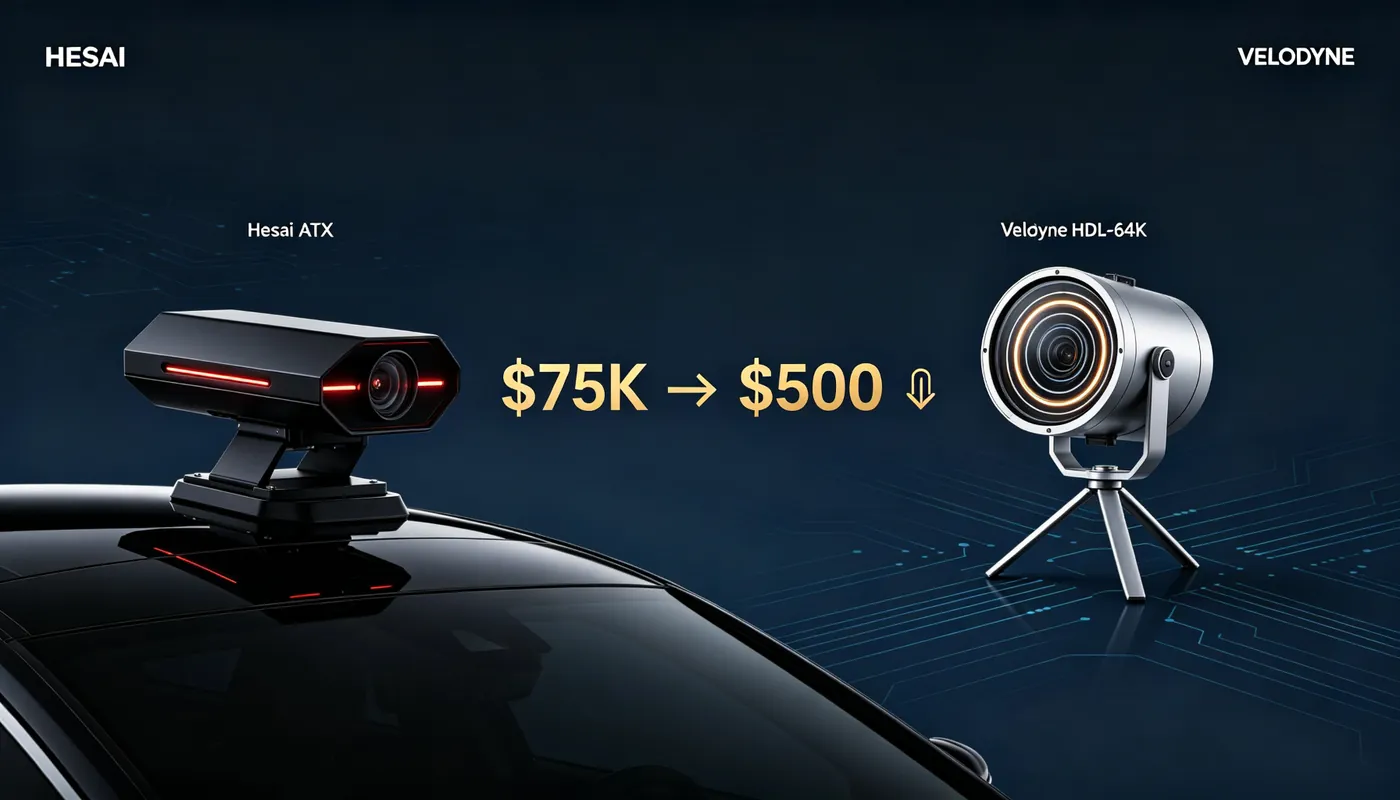
In 2017, if you were serious about self-driving, you bolted a Velodyne HDL-64E to your roof and paid $75,000. Waymo's Pacificas and Uber's Volvos all carried one — a 64-laser, mechanically spinning, hand-calibrated instrument that was as much a status symbol of autonomy research as a sensor. Velodyne, founded by David Hall in 1999, owned the industry.
Today the industry-standard long-range lidar is Chinese. Hesai (NASDAQ: HSAI) ships ADAS long-range lidar at an average price below $500 — a 99.5% reduction from the Velodyne benchmark — and Yole Group ranks it No.1 with a 43% share of the long-range ADAS market. The pioneer merged into Ouster in 2021 and its brand is gone. This is the lidar chapter of the story we have been tracking all week: China takes the volume market, America keeps the premium corner — and sometimes loses that too.
| Metric | Hesai (China) | Velodyne (USA) |
|---|---|---|
| 2017 benchmark price | — | HDL-64E $75,000 |
| Today's price | ADAS long-range <$500 avg (2026: ~$200 level) | Merged into Ouster (2021), brand retired |
| 2025 shipments | 1,620,406 units (+222.9% YoY) | n/a (no longer independent) |
| 2025 revenue | RMB 3.03B / $432.9M (+45.8%) | n/a |
| Profitability | First lidar company with full-year GAAP profit (RMB 436M, 2025) | Never profitable at scale |
| ADAS market share | 43% long-range ADAS (Yole, 2025) · No.1 five years running | Exited automotive |
| Robotics | 239,273 units (+425.8%) · No.1 in humanoid, quadruped, robotaxi, robovan, lawn mower | Pioneered robotaxi lidar, then lost it |
| Status | NASDAQ + HKEX listed · 2,071 patents (No.1, KnowMade) · 2M+ cumulative deliveries | Founded 1999 · SPAC'd 2019 · merged out 2021 |
Every number in that table points the same way. Here is how China did it, dimension by dimension.
The $75,000 HDL-64E of 2017 was a precision instrument: 64 discrete lasers, mechanically spun mirrors, and enough hand calibration to justify the price in a world where autonomy was a research project. Seven years later, Hesai's average selling price for ADAS long-range lidar is below $500 — and 2026-generation parts (Hesai's ATX, RoboSense's MX) are reported at the $200 level. That is a 99.5% collapse.
The consequences are visible in the car market: a lidar-equipped Chinese car now sells from about RMB 80,000 ($11,000), and lidar has moved from a $100K-vehicle luxury to a standard safety feature on mass-market models. When a sensor falls 99.5% in price in under a decade, the entire industry that refused to adopt it is reorganized.
Velodyne's machines were mechanical complexity: discrete lasers, photodetectors and rotating mirror groups, with the spinning assembly the most expensive, failure-prone part. China's answer was integration onto silicon. Hesai's in-house FMC500 system-on-chip fuses the MCU, FPGA and ADC on one die with functional safety and cybersecurity built in — cutting the bill of materials where it matters most (chips are ~40% of BOM).
The result is a product line with brutal economics: the OT128 360° long-range lidar (200 m at 10% reflectivity, 0.1° × 0.125° resolution) has 66% fewer parts than its predecessor and cuts per-unit production time by over 95%, running on automated lines. Solid-state and hybrid architectures mean fewer moving parts, higher reliability and a manufacturing process built for millions of units a year.
Hesai's 2025 results, reported in March 2026, are the industry's clearest numbers: 1.62 million units shipped (+222.9%), revenue of RMB 3.03 billion ($432.9M, +45.8%), and — a first for any lidar company ever — full-year GAAP net income of RMB 436 million. Yole Group's Automotive ADAS 2026 report puts Hesai at 43% of long-range ADAS lidar, No.1 for the fifth consecutive year, in a market where Chinese suppliers hold roughly 95% of automotive lidar overall.
In China's home market the concentration is even more extreme: 2025 main-lidar share was Hesai 41.5%, Huawei 28.2%, RoboSense 20.9% and Innolux/Tuyou 9.4% — a CR4 of essentially 100%. Hesai has design wins with 40 brands across 160+ vehicle models, including all top-10 Chinese OEMs and two top European OEMs — one is Mercedes-Benz, for an L3 program exceeding one million units.
Automotive made Hesai big; robotics is making it bigger. Robotics lidar shipments jumped 425.8% to 239,273 units in 2025, and Hesai is No.1 across four robotics submarkets (per GGII, Yole and Frost & Sullivan): humanoid & quadruped robots, robotaxis, robovans and robotic lawn mowers.
The flagship moment: Unitree equipped its humanoids with Hesai's JT128 at the 2026 Spring Festival Gala, the Chinese broadcast with a peak audience of 400 million, executing synchronized kung fu choreography. On the commercial side, Hesai has signed orders with Dreame and MOVA for robotic lawn mowers representing a backlog of over 10 million lidar units, and counts Unitree, HONOR Robot, Galbot, Magiclab and Vita Dynamics among robotics customers. The robotaxi era Velodyne once owned — 74% share in 2024 per Yole, serving nine of the world's top-10 autonomous driving companies — is now a Hesai business.
Velodyne's story ended in 2021: after dominating 2017-2019, going public via SPAC as VLDR in 2019, it merged with Ouster — an effective exit from independent competition. The pioneer's fate is now a case study in what happens when a precision-instrument business meets a volume-manufacturing one.
Hesai runs the opposite playbook: dual listing (NASDAQ HSAI, HKEX 2525), 2,071 patents (No.1 globally per KnowMade), in-house factories in China and Thailand scaling to 4 million units of annual capacity in 2026, a 2026 guidance of 3-3.5 million shipments, and selection as the primary lidar partner for NVIDIA's DRIVE Hyperion 10 platform. It is the first lidar company to turn a GAAP profit because it treats lidar as a scale business, not an instrument business — the same lesson Unitree applied to robot dogs and Estun to robot arms.
The takeaway: if you are specifying lidar for a car, robotaxi, robot or lawn mower in 2026, the cost-performance default is Chinese — Hesai's $200-500 long-range units, a 43% market leader with European OEM sign-offs, or RoboSense's alternative line. The $75K-era is over because the $500-era is better: smaller, solid-state, automotive-grade and profitable. For the full company story, see the Hesai company profile, and for the US-listed angle, our US-listed China robotics stocks analysis.
The full history, product line and financials of the world's No.1 lidar maker.
HSAI and the other China robotics names trading on American exchanges.
The consumer robotics giants that buy millions of lidar units a year.
The same China-vs-America price story, on four legs.
Spec sheets for Hesai, RoboSense, Unitree and 90+ more Chinese robot and component makers.