Unitree G1 vs Figure 02
China's $13.5K humanoid vs America's $130K humanoid — the same story, standing up.
The Go2 is the world's best-selling robot dog at $1,600. Boston Dynamics' Spot is the industrial gold standard at $74,500. That is a 47x gap — here is what each price actually buys you.
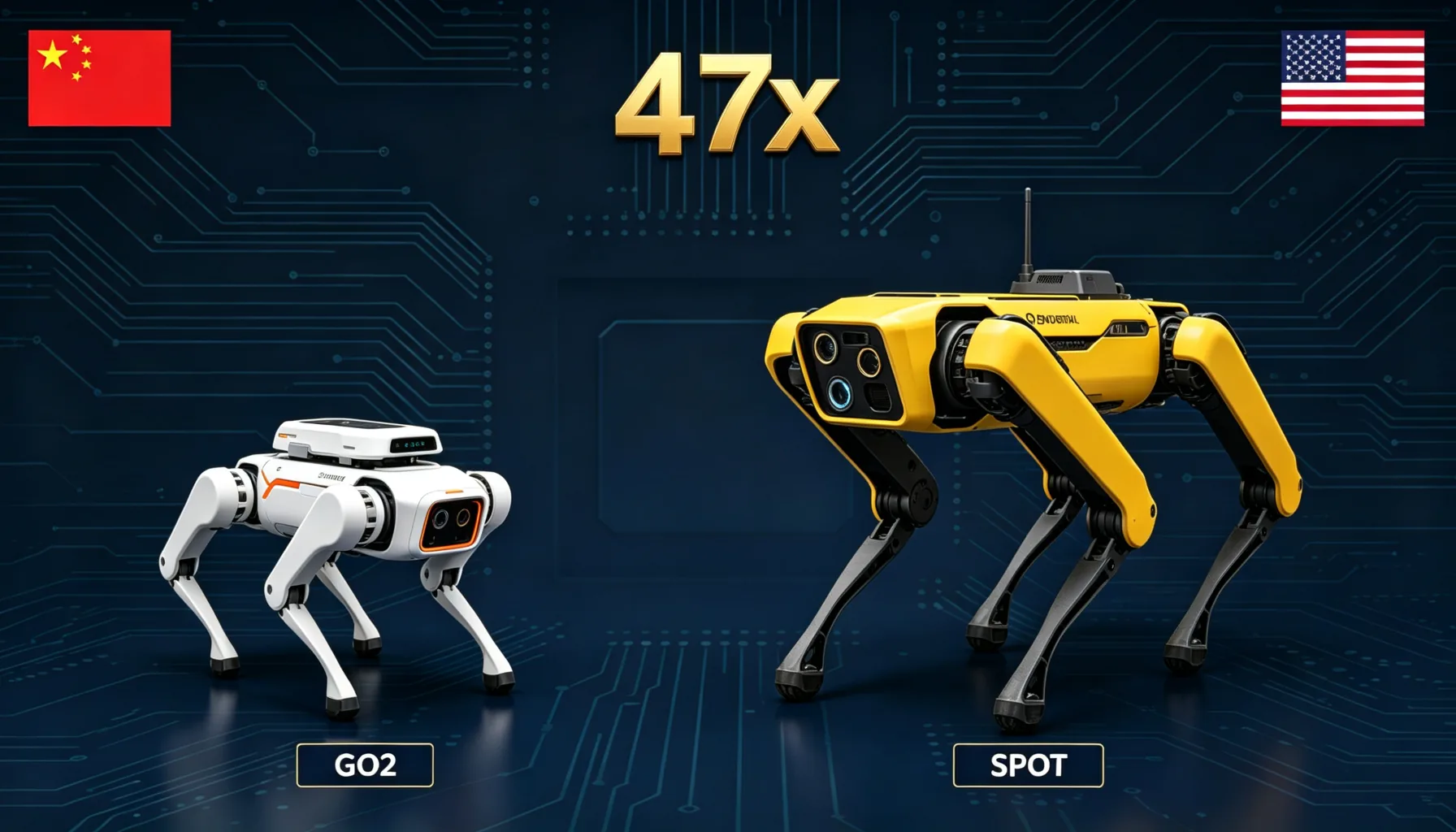
No two robot dogs better capture the US-China robotics divide than the Unitree Go2 and Boston Dynamics' Spot. One is a $1,600 product that ships to hobbyists by the tens of thousands. The other is a $74,500 industrial instrument that has become the default choice for oil rigs, power plants and construction sites. Same form factor, 47x apart on price — and both are right.
| Spec | Unitree Go2 (China) | Boston Dynamics Spot (US) |
|---|---|---|
| Starting price | US$1,600 (Air) · Pro $2,800 · EDU $3,790 | US$74,500 (Explorer) · $120K+ fully loaded |
| Availability | In stock, order online anywhere | Enterprise sales, lead times 4-8 weeks |
| Dimensions | 70 × 31 × 40 cm | 110 × 50 × 84 cm |
| Weight | ~15 kg | ~32.5-33.8 kg |
| Degrees of freedom | 12 | 12 (+6-DoF arm option) |
| Max speed | 2.5 m/s (Air) · up to ~5 m/s (X/EDU) | 1.6 m/s (5.8 km/h) |
| Payload | 7 kg (Air) · up to 12 kg (X/EDU) | 14 kg (20 kg max recommended) |
| Battery | 8,000 mAh · 1-2 h (15,000 mAh · 2-4 h EDU) | 564 Wh · ~90 min |
| Perception | Built-in 4D LiDAR L2 (360° × 96°) | 5 stereo camera pairs, 360° (LiDAR optional) |
| Ruggedness | IP54 | IP54, -20°C to 55°C |
| Software | Unitree SDK + ROS2, open developer ecosystem | Python/gRPC SDK, GraphNav, Autowalk, Orbit fleet mgmt |
| Deployment proof | World's best-selling robot dog; Unitree holds ~60-70% of global quadrupeds | 1,500+ units in customer hands (company figure; third parties estimate 3,000+) |
Read the table closely and you will find the whole story: China wins on price, speed and openness; America wins on payload, software maturity and the longest industrial track record in the category.
The Go2 Air starts at $1,600; the research-grade Go2 EDU — with full SDK, ROS2 and an optional Jetson Orin — is $3,790. Even the enterprise Go2 (3D LiDAR, cloud fleet tools) costs $8,900. For the price of a single Spot Explorer you can buy roughly 20 Go2 EDU units or 47 Go2 Air units.
Spot starts at about $74,500 for the Explorer bundle. Add the arm (~$65,000), thermal payloads, a charging dock (~$10,000) and enterprise software, and a working industrial configuration passes $120,000 — before annual software subscriptions that run $15,000-25,000. Unitree's total lineup, all models combined, costs less than one fully-loaded Spot.
The Go2 is the athlete: up to ~3.7 m/s on X/EDU models (5 m/s peak), half Spot's weight at 15 kg, and it carries a 4D LiDAR L2 built into every model — Unitree's own 360°×96° hemispherical sensor with 0.05 m minimum detection. It climbs 30-40° slopes, steps over 15-16 cm obstacles, and runs 1-2 hours (2-4 hours on the EDU's 15,000 mAh battery).
Spot is the workhorse: 14 kg of payload versus the Go2's 7-12 kg, a 300 mm step height, ±30° slopes, and a 360° perception stack that has been refined through six years of industrial deployment. Its 564 Wh battery runs about 90 minutes — comparable to the Go2 — and it self-rights, auto-charges and replans around obstacles on autonomous missions.
This is where the 47x gap starts to feel fair. Spot ships with GraphNav (map-and-replay autonomous routes), Autowalk (record a route by driving it once) and Orbit (fleet management with analytics), plus a mature Python/gRPC SDK and ROS2 support. For a company running 20 Spots across a chemical plant, that software is the product.
The Go2's answer is an open SDK and ROS2 with the largest developer community in quadruped robotics — the same playbook Unitree used to win the consumer market. Researchers can hack, extend and experiment freely, and the ecosystem of third-party projects around the Go2 is bigger than Spot's. But out of the box, the Go2 does not ship autonomous inspection workflows; that engineering is yours to do.
Spot has been commercially deployed since June 2020. Boston Dynamics reports over 1,500 units in customer hands (third-party analysts estimate 3,000+), across oil & gas, utilities, construction, mining and public safety — inspecting more than 130,000 industrial assets. It is the only robot dog with a six-year enterprise reliability record.
The Go2 is the volume king. Unitree's quadrupeds account for an estimated 60-70% of global robot-dog shipments, and the Go2 specifically has become the default choice for labs, universities, makers and light inspection — the same cost-discipline strategy Unitree is now applying to humanoids (see our G1 vs Figure 02 comparison).
The takeaway: the Go2 and Spot are not really competitors — they are two different products that happen to share four legs. China is proving that robot dogs can be consumer electronics; America is proving they can be enterprise instruments. The 47x price gap is the clearest single number in the whole US-China robotics story, and it is the same force now pulling humanoid prices down. For the components inside both machines, see who makes China's robot LiDAR, and for the company behind the Go2, read the Unitree company profile.
China's $13.5K humanoid vs America's $130K humanoid — the same story, standing up.
The Hangzhou company behind the Go2, B2, G1 and H2.
Hesai, Livox and the sensors that give Chinese robots their eyes.
Every spec of the world's most-shipped humanoid.
Spec sheets for Unitree, Deep Robotics and dozens more Chinese robot and component makers.