Harmonic Drive Suppliers
Leaderdrive and the precision-wrist monopoly break.
Every humanoid robot is assembled from about a dozen critical components — and China now leads most of them. This is the master guide: who makes each part, who leads, and how the pieces fit together.
Unitree — it has shipped 20,000+ humanoids with a global share above 30%, more than any other single maker. Underneath every unit sits a largely domestic component ecosystem.
A typical joint runs motor → encoder → reducer → screw/actuator, with force and tactile sensors at contact points, a LiDAR/camera head, and a dexterous hand on the end. China now has domestic leaders in every layer.
Zhongda Leader leads harmonic and planetary reducers (600k units/year, a 3.2B RMB Unitree contract); Shuanghuan Drive leads RV reducers (128k units, inside Xiaomi CyberOne Gen-2).
Almost. Encoders were the last gap — HCFA, Inovance and Yuheng now make 17-23 bit units good enough for humanoid joints at roughly 1/5 of Heidenhain's price.
China didn't just build the world's most humanoids — it built the most complete supply chain for them. Unitree alone shipped over 20,000 humanoids with a global share above 30%. Under every one of them sits a domestic component ecosystem that has, in a few years, turned "bottleneck" after "bottleneck" into commodity hardware. This guide maps all of it.
A humanoid joint stack runs: motor → encoder → reducer → screw/actuator, with force and tactile sensors at the contact points, a LiDAR/camera head, and a dexterous hand on the end. Ten guides below — one per component, each with the leaders and the numbers.
Reducers multiply torque. Harmonics own the precise wrist work, planetary carries the heavy legs and waist, RV bridges the industrial heritage. China's leaders: Leaderdrive (harmonic), Zhongda Leader (all three classes — Unitree's #1 supplier under a 3.2B RMB contract), Shuanghuan (RV).
→ Read: China's Harmonic Drive Suppliers
→ Read: China's Planetary Reducer Suppliers
→ Read: China's RV Reducer Suppliers
The joint itself. Inovance is the servo king and Optimus' early China supplier (10B+ RMB deal); Wolong, Moons' and HCFA build the frameless torque motors and integrated modules; Chinese costs undercut imports by 30-40%.
→ Read: China's Humanoid Actuator Suppliers
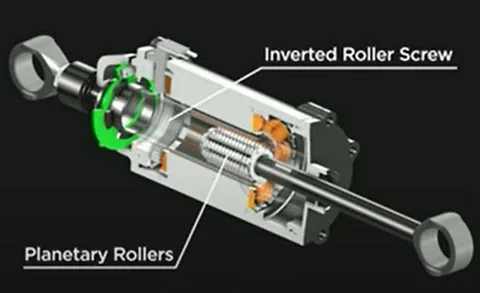
The linear actuators hidden inside legs and torso. Once a Bosch/Rollvis monopoly, now Wuzhou Xinchun, Hengli and Best scale production — and the price is collapsing as fast as humanoid volumes grow.
→ Read: China's Planetary Roller Screw Suppliers
The eyes of every joint — up to 54 per robot. Inovance shipped 1.24M units in 2025; HCFA packs a 12mm magnetic encoder at 17-23 bit; Yuheng pushes optical code discs past Heidenhain's wall.
→ Read: China's Encoder Suppliers
The heart of every finger. Moons' is the Optimus dexterous-hand supplier at a third of Maxon's cost; Zhaowei ships the ZWHAND; prices fell 67% as domestic volume took off.
→ Read: China's Coreless Motor Suppliers
The terminal that made Chinese humanoids famous. Inspire Robots and PaXini's DexH lead; micro motors, sensors and tendon drives combine in a 20+ DOF package — a category China effectively invented at scale.
→ Read: China's Dexterous Hand Suppliers
The sense of touch. Blue Dot owns ~73% of humanoid six-axis force; Kunwei leads smart-robot force sensing at 53%; PaXini and Hanwei build the flexible skins. Touch went from 90% imported to 100% domestic in eight years.
→ Read: China's Force & Tactile Sensor Suppliers
The eyes. Hesai, RoboSense and Innovusion turned solid-state LiDAR into a price war China won — the same components now ride on robot heads and industrial AGVs.
→ Read: China's LiDAR Suppliers
China's edge isn't any single component — it's that all of them live under one roof, within one logistics network, at prices 30-67% below imports. When Unitree cuts humanoid pricing by double digits year after year, the supply chain absorbs it. Competitors abroad buy components one by one; China's makers buy the whole stack.
This is the master map. Bookmark it, and check the company database for profiles of every firm named above.
Leaderdrive and the precision-wrist monopoly break.
Shuanghuan and the industrial-to-humanoid bridge.
Zhongda Leader's 3.2B RMB Unitree contract.
Inovance, Wolong, Moons' and the joint stack.
Hengli and the linear-motion price collapse.
Inovance, HCFA, Yuheng vs Heidenhain.
Moons' and the Optimus hand supply.
Inspire, PaXini and 20+ DOF fingers.
Blue Dot, Kunwei, PaXini, Hanwei.
Hesai, RoboSense and the price war.
Company profiles, product pages and supplier analysis for China's robotics ecosystem.