China's Frameless Torque Motor Suppliers
The rotary muscle of every humanoid joint — same supply chain, same story.
A humanoid walks on linear joints, and every linear joint runs on a planetary roller screw. The West still owns ~80% of global high-end supply — Nanjing Gongyi, Wuzhou Xinchun and Hengli are closing the gap, fast.
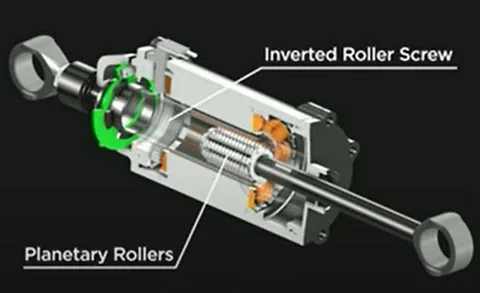
A humanoid robot doesn't only rotate — it pushes. Every squat, stride and finger pinch comes from linear motion, and in the flagship humanoids of this generation that linear motion is generated by a planetary roller screw: a screw whose threaded rollers share the load, turning motor spin into thousands of newtons of linear thrust. Tesla's Optimus packs 14 of them across its arms and legs; analysts estimate roller screws are a humanoid's single most expensive mechanical part, roughly 19% of mechanical cost per unit.
A planetary roller screw is a ball screw's stronger cousin. Where a ball screw transmits load through point contact on a few balls, a roller screw spreads it through line contact across multiple threaded rollers — giving roughly 3-10x the load capacity of a comparable ball screw, better stiffness, longer life and superior impact resistance. A standard 20mm-diameter roller screw can take about 50,000 N of axial load where a same-size ball screw tops out near 5,000 N. That is exactly the duty a humanoid's hip, knee and shoulder demand: high force, high cycle life, and the self-locking ability to hold a pose with the motor off — saving battery while the robot stands.
High-end planetary roller screws remain a Western oligopoly. European names such as SKF, Rollvis and GSA (plus Ewellix and Tolomatic in actuators) hold roughly 80% of global premium share, with China's domestic makers collectively under 20%. The barrier is manufacturing, not design: roller screws need ultra-precision thread grinding, specialized machines and years of process know-how. Chinese suppliers crossed into mass production only around 2024-2025 — and they are scaling fast on the back of the humanoid boom.
| Company | Nanjing Gongyi (南京工艺) | Wuzhou Xinchun (五洲新春) | Hengli (恒立液压) | Tuopu (拓普集团) |
|---|---|---|---|---|
| Role | China's #1, ~8-14% domestic share | Reverse roller screw leader, ~10% share | Hydraulics giant crossing over | Integrated actuator supplier |
| 2026 signal | Φ16-32mm full series; 14.2-day delivery | 87k units in 2025; average price -39% | Roller screws in trial production; Tesla samples | Optimus executor module supplier, 300k units/yr |
| Edge | First dedicated roller screw grinding line in China | Bearings pedigree + cost machine | Precision machining at hydraulic scale | Motor + reducer + screw in one module |
State-backed Nanjing Gongyi Equipment Manufacturing (南京工艺装备制造) is China's largest maker of rolling-function components and the clear #1 in domestic planetary roller screws, with roughly 8-14% of the China market depending on the report. It already mass-produces the full Φ16-32mm series and has built the country's first dedicated roller screw grinding line, compressing lead time to about 14.2 days versus an industry average near 28.6 days. That combination of precision, range and speed makes it the default reference point for Chinese humanoid OEMs today.
Bearing specialist Wuzhou Xinchun (五洲新春, 603667) holds roughly 10% of China's planetary roller screw market and has become the benchmark for cost-down. In 2025 it shipped about 87,000 reverse planetary roller screws at an average price of ~1,360 yuan, down 39% year over year — the clearest sign that roller screws are heading down the same cost curve that made harmonic drives and frameless motors Chinese commodities. Its tie-up with Xinjian Transmission (新剑传动) gives it a door into the global humanoid supply chain.
Hengli Hydraulic (恒立液压, 601100) is the most watched crossover: the hydraulics and precision-machining champion is applying decades of high-precision manufacturing to screws, with ball screws already in small-batch delivery and planetary roller screws in trial production — and it has sent samples to Tesla and others. Tuopu (拓普集团) takes the integration route as Tesla Optimus' exclusive Tier-1 for linear/rotary executor modules, with 300,000-unit annual capacity in Ningbo and a Mexico plant online. Beste (贝斯特) reached C0-grade ball screws via its Yuhua subsidiary plus Germany's KISSLING, and Bote Precision (博特精工) holds ~8% share. Auto-parts players like Bete Technology (北特科技) round out a deep bench.
Three structural advantages explain the surge. First, machine-tool self-sufficiency: China now builds its own thread-grinding machines (Qinchuan Machine Tool produces them in-house), removing the historical dependency on imported precision grinders. Second, reverse roller screw economics: the inverted design simplifies manufacturing and cuts cost dramatically — Wuzhou Xinchun's 39% price drop in a single year shows how fast that curve moves. Third, integrated executor modules: Tuopu and Sanhua sell motor + reducer + screw as one tuned assembly, exactly what humanoid OEMs want to avoid stitching five vendors together.
Nanjing Gongyi (南京工艺) is China's #1 planetary roller screw maker with roughly 8-14% domestic share, full Φ16-32mm series mass production, and the country's first dedicated roller screw grinding line.
Line contact spreads load across multiple rollers, giving planetary roller screws roughly 3-10x the load capacity of ball screws and far better impact resistance — ideal for the high-force linear joints of a humanoid's legs and arms.
Tesla's Optimus packs 14 reverse planetary roller screws across its arms and legs. Roller screws are typically a humanoid's most expensive mechanical part — around 19% of mechanical cost per unit.
Western makers such as SKF, Rollvis and GSA still hold roughly 80% of global high-end share, but Nanjing Gongyi, Wuzhou Xinchun, Hengli Hydraulic and Tuopu are now in mass production or Tesla validation.
The rotary muscle of every humanoid joint — same supply chain, same story.
The full joint stack — motors, reducers, screws and the companies that assemble them.
The bearing leader turned roller screw cost-killer.
The hydraulics champion crossing into humanoid linear drives.
Company profiles, product pages and supplier analysis for China's robotics ecosystem.