Unitree G1 — Product Page
Full G1 product profile with specs, actuators and supply chain.
The Unitree G1 is the world's most-shipped humanoid robot. Here is every spec that matters — and why it changes the economics of the humanoid industry.
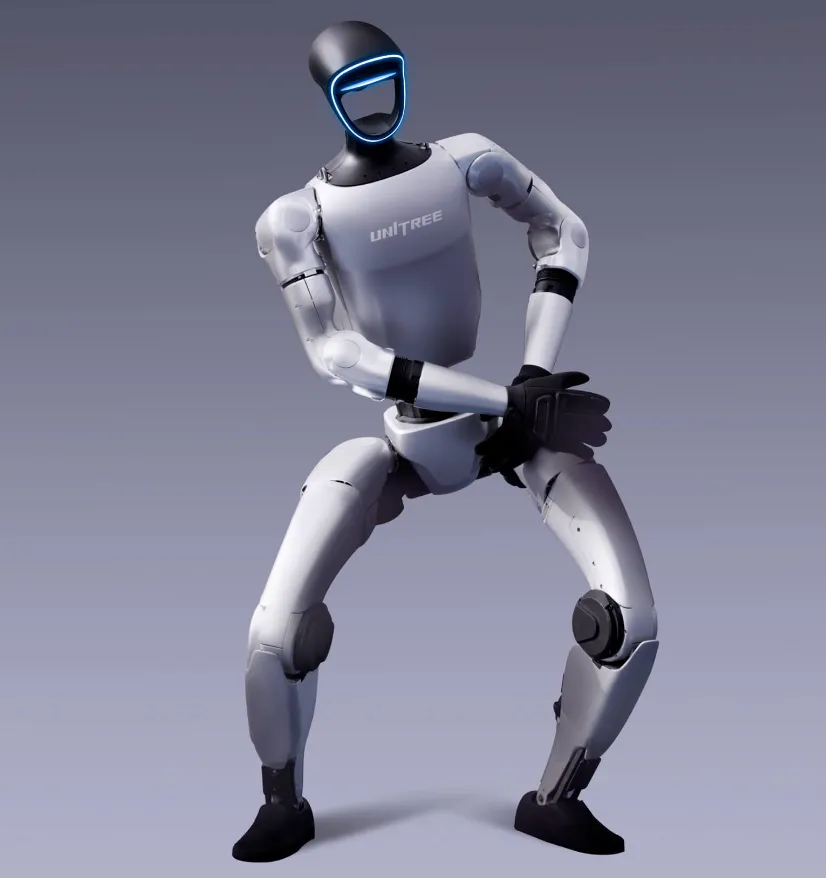
If you search for "Unitree G1 specs" you are probably trying to answer one question: can a $16,000-ish humanoid actually do useful work? The short answer — that is precisely why the G1 is the best-selling humanoid robot on the planet. This is the full breakdown.
| Height | Approx. 127 cm (4 ft 2 in) |
|---|---|
| Weight | Approx. 35 kg (77 lb) |
| Degrees of freedom | 23 in the body (plus hand DOF) |
| Walking speed | Up to ~2 m/s |
| Hands | Three-finger dexterous hands, 12 DOF total |
| Joints | Unitree M107 joint motors with high torque density |
| Battery | Swappable battery, ~2-hour typical operation |
| Sensors | 3D LiDAR, depth cameras, IMU |
| Price | From ~US$16,000 (education/reference config); lower entry in China |
The headline number is the price. The G1 is dramatically cheaper than any comparably capable full humanoid, which is what let Unitree turn a lab curiosity into a product that ships by the thousands.
| Size | G1 ~127 cm / ~35 kg | Optimus ~173 cm / ~57 kg |
|---|---|---|
| Focus | Cost, agility, education & R&D | Full-size factory & household work |
| Hands | Three-finger, 12 DOF | Five-finger, human-like |
| Price | ~US$16,000 class | Targeted far higher, not yet fixed |
| Deployment | Thousands shipped | Pilot production |
| Software | Unitree SDK + AI ecosystem | Tesla FSD-derived neural nets |
The honest read: Optimus is aiming at the full-size, factory-ready end of the market, while the G1 is winning the volume game today. If the humanoid industry's "iPhone moment" is about getting to millions of units, the G1 is showing the pricing path — and China's supply chain is what makes that price possible.
The takeaway: the G1 matters less as a single robot and more as proof that humanoids can be built at consumer-electronics prices. For engineers and investors tracking the humanoid race, the G1's spec sheet is the baseline every Chinese rival — AgiBot, Kepler, EngineAI — is now competing against.
Full G1 product profile with specs, actuators and supply chain.
The Hangzhou company behind the G1, Go2 and H1.
How the world's best-selling humanoid compares to Shanghai's industrial challenger.
The K2 full-size humanoid targeting industrial deployment.
Spec sheets for Unitree, AgiBot, Kepler and dozens more Chinese humanoid and component makers.