Unitree G1 Specs — Full Breakdown
Every G1 specification, sensor and supply-chain detail.
The G1 is the world's most-shipped humanoid at $13,500. Figure 02 is America's most-deployed enterprise humanoid at an estimated $130,000+. Same decade, opposite strategies — here is the spec-by-spec reality check.
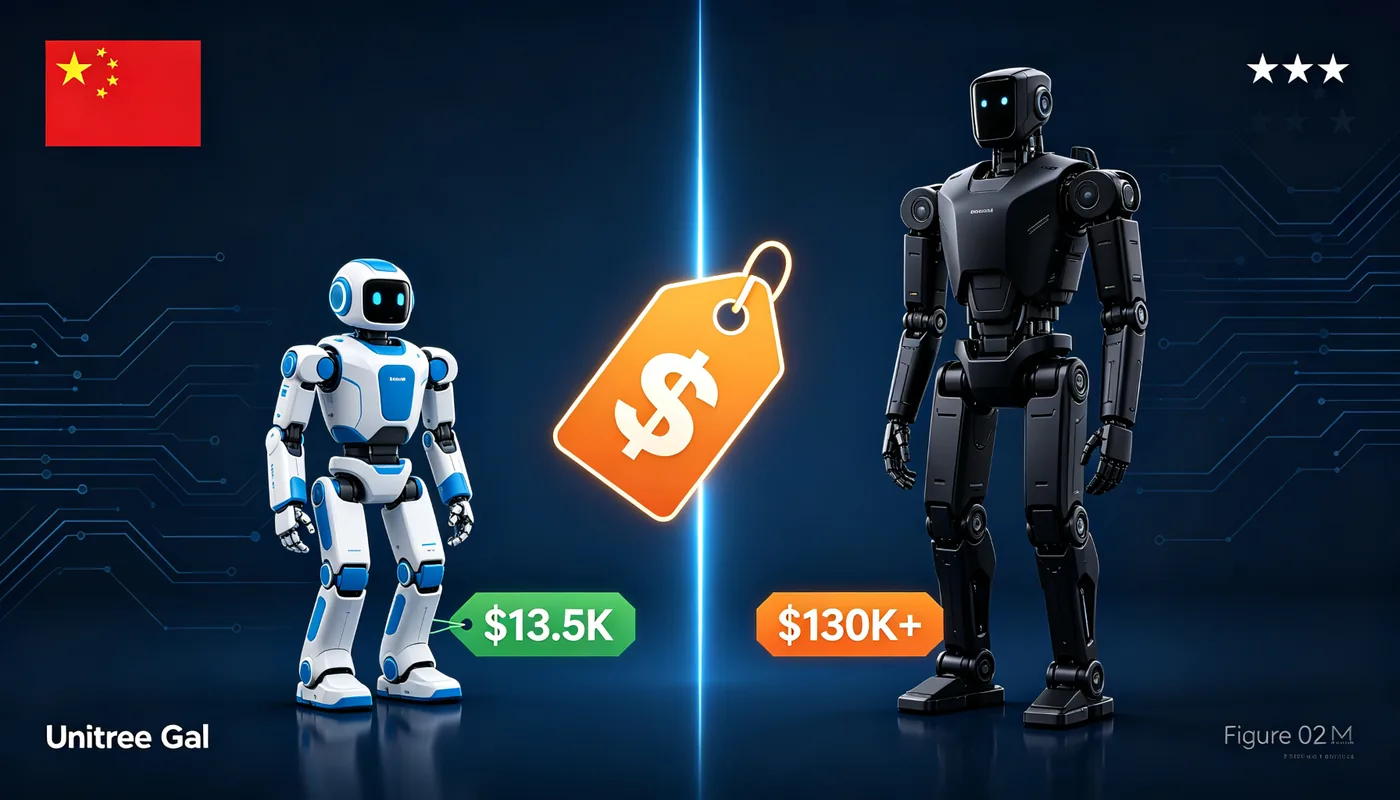
Ask a robotics engineer in 2026 which humanoid robot matters and you get two answers: Unitree G1 because it ships by the thousands at a price any lab can afford, and Figure 02 because it is the most credible enterprise deployment in the West — working daily at BMW. These two robots are the clearest possible illustration of the US-China divide in humanoid robotics, and the gap between them is roughly a factor of ten on price and a world apart on strategy.
| Spec | Unitree G1 (China) | Figure 02 (US) |
|---|---|---|
| Price | US$13,500 base (up to $73,900 fully equipped) | No public MSRP; est. $130,000+ |
| Availability | Commercially available — order online, any buyer | Enterprise partner program only (BMW et al.) |
| Height / Weight | ~132 cm / ~35 kg | ~168–170 cm / ~60–70 kg |
| Degrees of freedom | 23–43 (config-dependent) | ~35 (16-DoF hands) |
| Payload | ~2–3 kg per arm | ~25 kg; 20 kg carry |
| Hands | Optional 3-finger (Dex3-1) or 5-finger (Dex5-1) | 16-DoF five-finger, among the most dexterous shipped |
| Walking speed | Up to ~2 m/s | ~1.2 m/s |
| Battery | ~2 hours (swappable) | ~5 hours (2.25 kWh) |
| AI stack | UnifoLM + open SDK, ROS2 | Proprietary Helix VLA, dual NVIDIA GPUs, on-device inference |
| Deployment proof | Mass-produced, largest installed base in the world | BMW Spartanburg — 10-hour daily shifts since early 2025 |
Read those two columns carefully and you will see the entire US-China humanoid story in one table. China sells capability at consumer-electronics prices. America charges enterprise prices for a closed, deeply-integrated product. Neither is wrong — they are built for different customers.
The G1 launched at $16,000 in May 2024 — roughly one-sixth the price of Unitree's own H1 and a fraction of every Western humanoid. Unitree's current listing is $13,500 for the base configuration, with 16 configurations spanning up to $73,900 for the fully-equipped research platform. Anyone — a university lab, a startup, an individual — can order one online.
Figure 02 is the opposite. Figure AI raised about $1.9 billion at a $39 billion valuation, yet the robot itself has no public price because it is never sold. Robots are deployed under partner agreements, primarily at BMW's Spartanburg plant, where Figure 02 units have run 10-hour daily shifts on X3 body-shop assembly since early 2025. Third-party trackers estimate the hardware at $130,000+. In practice, if you are not a Fortune 500 manufacturer, you cannot get one at any price.
Figure 02 is a full-size industrial robot: 168–170 cm, 60–70 kg, a 25 kg payload and 16-DoF five-finger hands that are among the most dexterous in the industry. Its 2.25 kWh battery runs about five hours — enough for shift work with rotation. This is hardware built to touch car parts.
The G1 is a compact research platform: 132 cm tall, 35 kg, roughly 2–3 kg per arm. It cannot reach a standard countertop, let alone lift a door panel. What it gives up in size it makes up in agility (up to 2 m/s walking, side flips, dancing) and — crucially — in being there. There are thousands of G1s in labs around the world today; there are hundreds of Figure 02s at BMW.
Figure's moat is software. The 02 runs Helix, Figure's proprietary vision-language-action model, on dual NVIDIA GPUs with roughly 3x the on-device inference of its predecessor. The whole stack — perception, language, manipulation — is designed in-house, and the company ended its OpenAI collaboration in early 2025 to go fully vertical.
Unitree's answer is not a single model but an ecosystem: the UnifoLM foundation model plus a genuinely open SDK and ROS2 support that has produced the largest developer community of any humanoid platform. The trade-off is real — G1 manipulation trails Figure's hands in dexterity — but for researchers who want to write their own code, the open platform is the point.
These are two different industrial theories. Unitree, backed by China's component supply chain, mass-produces at consumer-electronics economics — the same playbook that made its quadruped Go2 the world's best-selling robot dog. Figure, backed by $1.9 billion and a $39 billion valuation, built BotQ, a San Jose facility rated at 12,000 robots a year, staffed partly by its own humanoids, and is vertically integrating actuators, compute and AI.
There is an even sharper number underneath all of this. Adjusted for configuration, the G1 costs about $372 per degree of freedom; Figure's own consumer-targeted Figure 03 aims for under $455/DOF at a sub-$20,000 price point — a price that would be unthinkable without the cost curve China's supply chain has already forced on the whole industry.
The takeaway: China is winning the price-and-volume war while the US leads on AI depth and enterprise proof. The G1 shows humanoids can be built like smartphones; Figure 02 shows what they can do when a BMW budget is behind them. The race will be decided by who crosses into the other's territory first — and China's supply chain is already making that crossing cheaper every quarter. For the investment side of this story, see our guide to US-listed China robotics stocks, and for the parts inside both robots, read who really supplies humanoid actuators.
Every G1 specification, sensor and supply-chain detail.
The Hangzhou company behind the G1, H1 and Go2.
XPeng, Faraday Future, Hesai — how US investors get China robot exposure.
The $12B muscle market: Sanhua, Tuopu and who supplies Tesla and Unitree.
Spec sheets for Unitree, AgiBot, Kepler and dozens more Chinese humanoid and component makers.