Unitree G1 vs Figure 02
China's $13.5K robot vs America's $130K bet — the same gap one rung down.
Unitree sells a full-size humanoid for $29,900. Boston Dynamics will not sell you an Atlas at any price — and when industry analysts price one, they land near $420,000. The same machine category, separated by a 14x gap. Here is what the gap buys, and what it does not.
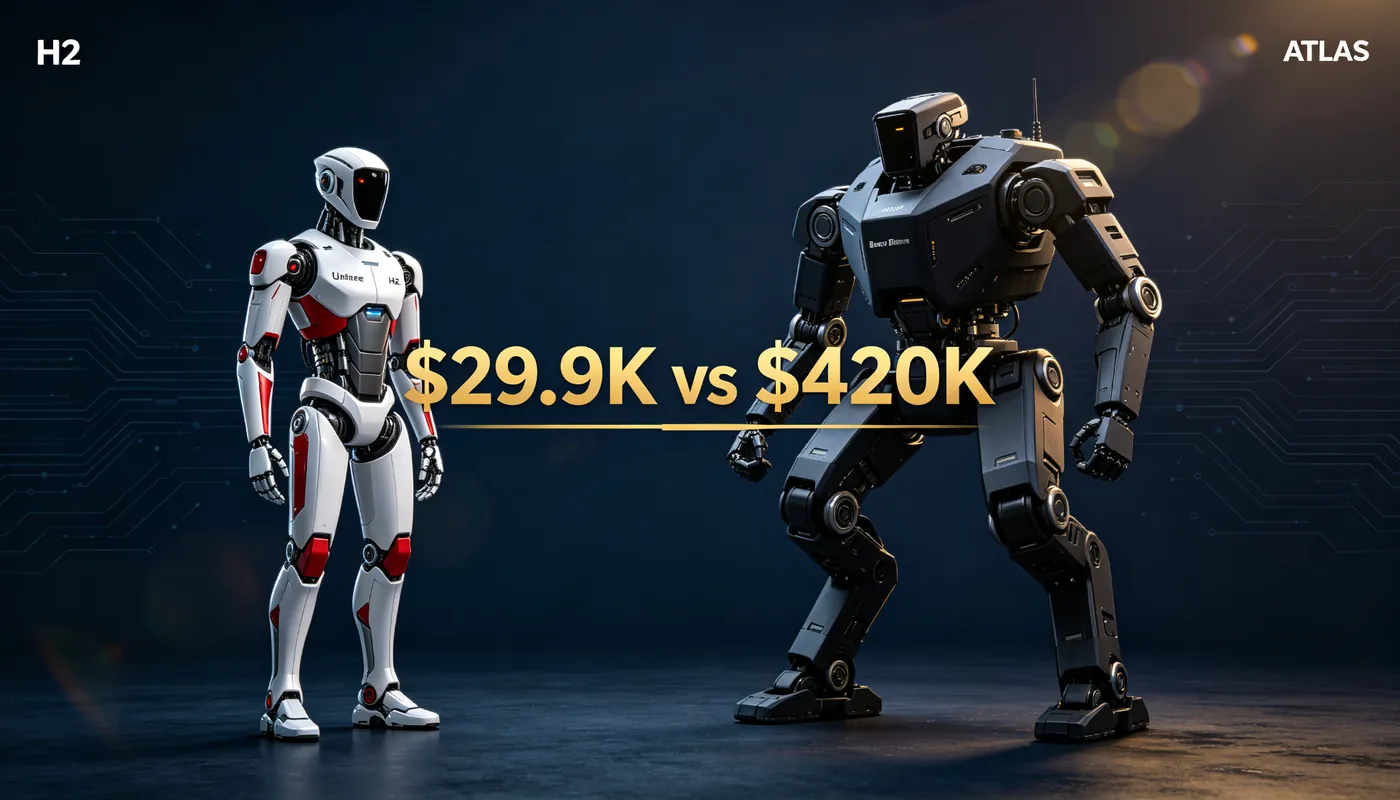
Open Unitree's website and you can order the H2 — a 1.82 m, 70 kg, 31-DoF full-size humanoid — for $29,900. Tax and shipping excluded, warranty included, order now. Open Boston Dynamics' site and you will find the electric Atlas as a research and pilot machine: no price, no store, no sales contact. When analysts estimate what an Atlas-class humanoid would cost to build and sell, the number that keeps coming back is around $420,000 — roughly 14 times the H2.
This is the cleanest price story in robotics since our Go2 vs Spot and G1 vs Figure 02 comparisons — a Chinese company selling a product, against an American company selling a research program. Here is the head-to-head, dimension by dimension.
| Metric | Unitree H2 (China) | Boston Dynamics Atlas (USA) |
|---|---|---|
| Price | $29,900 on Unitree's site (EDU: contact sales) | Not for sale — industry estimate ~$420,000 (14x) |
| Size / weight | 1820 × 456 × 218 mm · ~70 kg | ~1.9 m · heavy-duty build |
| Degrees of freedom | 31 (leg 6 / arm 7 / waist 3 / head 2) | 56 |
| Joint torque | Arm 120 N·m · Leg 360 N·m (peak) | Not published (full-body dynamic class) |
| Payload | Rated ~7 kg · peak ~15 kg | Repeated 30 kg · peak 50 kg |
| Battery life | ~3 h (15 Ah / 0.972 kWh) | ~4 h |
| Onboard AI compute | Intel Core i5 + optional Jetson AGX Thor (2,070 TOPS) | Hyundai + Google DeepMind AI stack |
| Buyability | Catalog product, SDK2, OTA, EDU variant, 8–12 month warranty | Research/pilot only — no commercial sale |
| Deployment proof | Industrial/service pilots, global reseller network | Hyundai Georgia plant pilot planned for 2028 |
The table captures the real split: Atlas is stronger, more articulated and backed by DeepMind-scale AI — but it is a flagship that cannot be bought. The H2 is a product that ships. Now the five dimensions that matter if you are actually in the market.
Unitree's own product page lists the H2 at $29,900; the H2 EDU (with secondary-development support and optional dexterous hands) is quote-only. European resellers like OpenELAB list the H2 at €47,399 including VAT, and a Norwegian distributor at NOK 656,250 excluding VAT — premium markups, but still a shoppable price in every market.
Boston Dynamics has never quoted an Atlas price. Third-party analyses of the electric Atlas program — published by robotics reviewers and teardown specialists — consistently estimate an Atlas-class humanoid at $150,000 to $250,000 at product price, and up to ~$420,000 for an early-program machine. Either way you slice it, the delta to the H2 is an order of magnitude. That is the entire story of the Chinese pricing model: sell at scale, price like hardware, not like a moonshot.
The H2 is no toy: aerospace-grade aluminum and titanium alloy, industrial crossed-roller bearings, low-inertia PMSM motors, 120 N·m peak arm torque and 360 N·m peak leg torque — the same class of leg torque that made the H1 famous, in a cleaner 31-DoF body. Rated arm payload is ~7 kg (peak ~15 kg), battery life is about 3 hours on a 0.972 kWh quick-release pack, and everything is air-cooled for 24/7 lab duty.
Atlas is a different weight class. The electric Atlas shown at CES 2026 has 56 degrees of freedom, repeatedly lifts 30 kg (50 kg peak), runs ~4 hours, and performs the parkour-grade dynamic motions Boston Dynamics is known for. On raw strength and articulation, Atlas wins outright — but it wins on a machine no company can purchase. For a buyer, the H2's numbers are the ones that exist in a price list.
Unitree positions the H2 as an embodied-AI platform: the base unit runs an Intel Core i5 for platform functions, and the H2 EDU accepts a Jetson AGX Thor module at 2,070 TOPS. The new H2 PLUS ships with a Jetson T5000 (2,070 TFLOPS FP4), dual five-finger tactile hands with 22 active DoF each, and 75 total body-and-hand DoF — built to run NVIDIA Isaac GR00T foundation models out of the box.
Atlas pairs with Google DeepMind, with Hyundai industrial expertise behind it — arguably the strongest AI partnership in humanoid robotics today. If your goal is frontier whole-body policy research at any cost, Atlas's stack is the benchmark. If your goal is to run real embodied models on a robot you own, the H2 is the platform you can actually deploy this quarter.
Unitree's H2 builds on the company's volume playbook: H1 ran on China's 2025 Spring Festival Gala stage, the G1 has shipped in five figures, and the H2 now flows through a global reseller network with a documented warranty (8 months standard, 12 months EDU). The H2 is not a concept — it is a stocked SKU.
Atlas's deployment timeline is a 2028 Hyundai Georgia automotive plant pilot, with Hyundai and DeepMind positioning it for factory tasks that today's fixed automation cannot do. That is a milestone for the industry — and a reminder that the American flagship is years from being a purchasable product, while the Chinese one is on a shelf.
The H2's economics are simple: manufacture, list, ship, iterate via OTA — a hardware business with a consumer-electronics rhythm. Unitree is effectively building a distribution channel for humanoids the way it did for robot dogs (see our Go2 vs Spot analysis of the $1,600 vs $74,500 dog market).
Atlas is an R&D flagship inside a larger Hyundai mobility bet. The robot's value to Boston Dynamics is strategic — capability proof, talent, and a beachhead for future commercial products — not unit economics. Neither model is wrong; they are simply different answers to the same question: how do you put a humanoid in the world?
The takeaway: if you need a full-size humanoid to own, develop on or show — buy the H2 at $29,900, and use the ~$390,000 you saved on compute, hands and a deployment team. Treat the $420K Atlas figure as the true benchmark for what frontier humanoids cost when a vendor finally prices one; it tells you how much headroom China's pricing model still has. For the broader race, see The Humanoid Robot Race and the Unitree company profile.
China's $13.5K robot vs America's $130K bet — the same gap one rung down.
$1,600 vs $74,500: how Unitree's pricing model took over four-legged robotics.
The full history and product line of China's humanoid price disruptor.
Where China, the US and Europe stand in the race to commercial humanoids.
Spec sheets for Unitree, Fourier, UBTECH, AgiBot and 90+ more Chinese robot and component makers.