Nvidia Without Jensen Huang: Which Chinese Robot Makers Are Exposed?
The compute question behind every humanoid on that street.
Shenzhen spent a week showing robots to the Asia-Pacific. Unitree supplied the founder and the performance. The robots that actually worked the summit — making coffee, pouring beer, greeting guests — came from other companies. That split says more about where Chinese humanoids are commercially than any keynote did.
Shenzhen got the Asia-Pacific for a week. The 33rd APEC Economic Leaders' Meeting ran November 18–19; the CEO Summit ran November 17–18 at the Qianhai International Convention Center, with more than 2,000 business and government delegates and 115 Fortune Global 500 companies on the list. The city used the window the way it knows how: not with a convention-hall exhibit, but by putting robots on streets, in newsrooms, in parks and in stores, and letting visiting journalists film them.
Unitree was part of that, in the way a well-known brand is usually part of a big local event — prominently, photogenically, and at one remove from the actual work. Its founder spoke. Its robots performed. The operational roles went elsewhere.
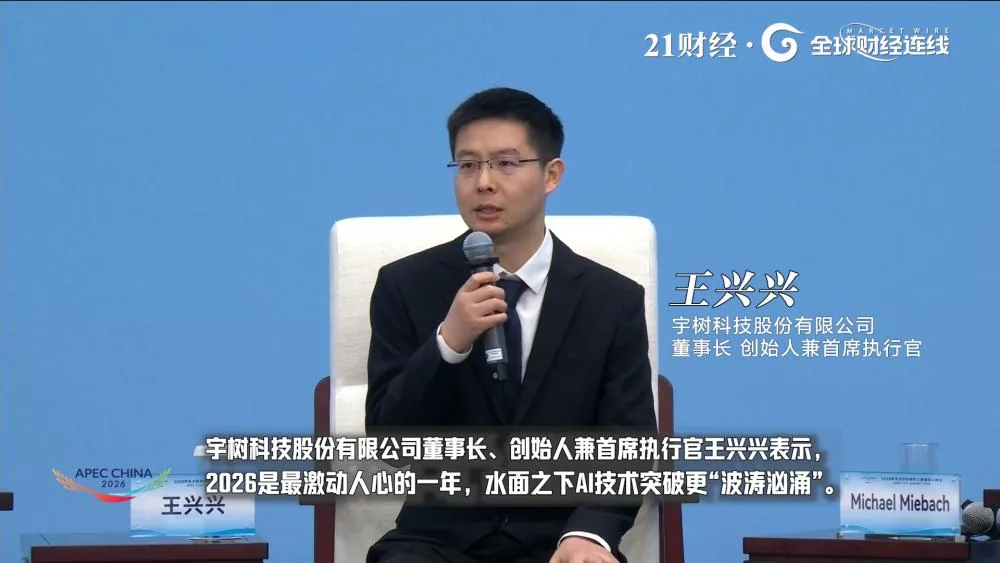
Wang took the panel "Building an open and inclusive AI innovation ecosystem" on November 17, alongside Baidu's Robin Li. Zhejiang Daily noted, with some affection, that he was the only speaker in white sneakers. The substance was more interesting than the footwear.
His central image was vertical. What ordinary people see of AI and robotics, he said, is the part above the waterline; below it, progress is "more turbulent" and faster than public perception. That is a founder's standard optimism, but he attached two caveats that are unusual in a keynote setting.
The first was technical. Model generalisation — the ability to carry one policy across tasks and environments — is the biggest constraint, and he believes it is close to a breakthrough. That claim is consistent with what Unitree has been demonstrating: in October, at its own ecosystem conference, it showed a G1 being driven by GPT-6 with no pretraining or planning pipeline, painting and rinsing a brush. Impressive as a demo; not yet a product.
The second was industrial. If demand jumps from tens of thousands of units to millions or tens of millions, he said, the pressure moves to manufacturing reliability and after-sales service. That is the sentence worth underlining. It is the same bottleneck that overseas distributors complain about with Chinese humanoids: the unit arrives, the demo works, and then a joint module fails in week nine with no local technician and a six-week parts cycle.
He also conceded something Chinese executives rarely say on an international stage: China is strong in manufacturing but still weak in frontier AI models, compute and top-end AI talent. His argument for cooperation followed from that — grow the market rather than fight over share, and note that more than one-third of the partners at Unitree's October ecosystem conference were from outside China.
That is a coherent pitch. It is also a pitch, delivered to an audience of potential partners and buyers rather than to a procurement officer.
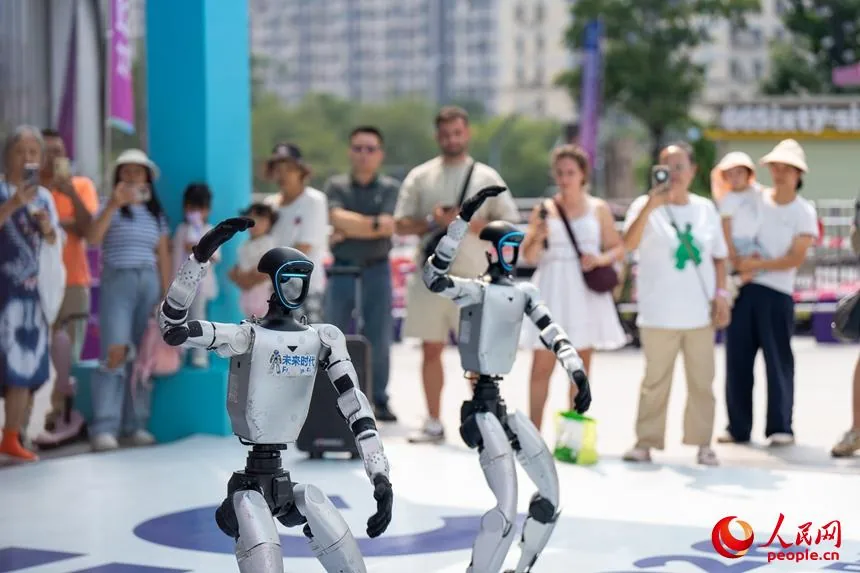
The performance was in Longgang, at the robot street around the world's first robot 6S store — a four-floor retail and experience building that sells, leases, services and customises robots from Unitree, EngineAI, LimX Dynamics and others. On November 16, the first batch of the APEC foreign-media tour arrived. A German reporter told Southern+ that what impressed him most was not a specific trick but the walking ability, and that Germany has far fewer humanoids to show.
What the cameras got was a show. A Korean correspondent from Edaily, visiting on November 13, watched a Unitree G1 perform a drunken-boxing routine — staggering, swinging, then kicking up into the air — while an EngineAI T800 ran through boxing moves including a jumping uppercut. During the media tour, Unitree humanoids performed martial arts as a group, according to Jiemian. The crowd was thick with phones.
Foot traffic explains why the store bothers. Its manager told Southern+ that in the week before the summit the store was receiving about 1,000 foreign visitors a day, more than 45% of all visitors, with tour groups from Vietnam, Singapore and Malaysia. A robot that can hold a pose for a phone camera is, in that setting, a sales tool. The same building runs a robot restaurant, a boxing ring and a drone-control demo.
One clarification matters for the record: the 151 humanoid robots that danced for an hour in Longgang on November 17 and set a Guinness World Record were organised by Future Era Robotics, the company behind the 6S store, not by Unitree. The record is a real signal about cluster coordination and hardware stability in Shenzhen. It is not a Unitree milestone, and several overseas posts have blurred the two.
Inside the APEC machine, the robots doing repetitive work were a different roster. At the Leaders' Meeting week news centre, seven "Aibao" humanoids from Zhipingfang made coffee, ice cream and juice — the company says 45 cups of coffee, 30 ice creams and 30 juices per hour across the seven units. In the rest area, Zibianliang's "Yezai" handed out snacks and water and took the rubbish. UBTech's Walker C1 greeted guests at the Qianhai "Bay Reception Hall". Kuaiwei's "Xiaowei" poured beer and milk tea at Qianhai Stone Park, where Meituan also flew delivery drones and rolled out its "Little Yellow Bee" delivery robot.
These are press-reported deployments, not audited contracts, and several are demonstration agreements dressed as service. But the pattern is visible: the companies that got the operational slots were the ones selling service labour, not athletic capability. Unitree's G1 is a research and performance platform with a 127cm frame and a price that makes it attractive to labs and event organisers. It was never designed to bus coffee for 2,000 delegates.
| Company | What it did at APEC week | Where | Nature |
|---|---|---|---|
| Unitree | Founder panel; G1 martial-arts performances for media | CEO Summit (Qianhai); robot street (Longgang) | Brand and demo |
| Zhipingfang | Seven "Aibao" humanoids making coffee, ice cream, juice | News centre | Service demo at scale |
| Zibianliang Robotics | "Yezai" handing snacks, water, waste | News centre rest area | Service demo |
| UBTech | Walker C1 greeting guests | Qianhai Bay Reception Hall | Front-of-house demo |
| Kuaiwei Intelligent | "Xiaowei" pouring beer and milk tea | Qianhai Stone Park | Retail demo |
| Future Era Robotics | 151-robot Guinness record | Longgang robot street | Cluster performance |
Sources: China News Service, Jiemian, CCTV, Southern+ and company statements, November 2026. "Nature" is editorial classification, not a contract description.
Unitree listed on the Shanghai Stock Exchange's STAR Market on August 19, 2026, at RMB 150.80 per share, raising about RMB 6.1 billion at an IPO price that implied a 219x price-to-earnings ratio. The stock opened above RMB 1,100, peaked at a market value north of RMB 440 billion, then fell more than 60% before rebounding in late October. On November 17, the day of Wang's panel, it closed at RMB 639.94, valuing the company at about RMB 258 billion, according to Southern Metropolis Daily.
The first post-IPO quarterly report, published October 28, is the more useful document. Third-quarter revenue was RMB 665 million, up 69.9% year on year. Net profit attributable to shareholders was RMB 112.7 million, down 17.4%. R&D spending in the quarter was RMB 127 million, up 249.6% and equal to 19.1% of revenue. For the first nine months, revenue reached RMB 1.817 billion (+55.7%) and net profit RMB 386.7 million (+270.5%), but recurring profit fell 18.8% and operating cash flow fell 54.7%.
Read those lines together and you get the strategic picture: Unitree is spending heavily to build a model stack it admits it does not yet have, while its hardware business is still growing fast enough to fund the effort. The company's pitch is no longer "cheap quadruped, great videos". It is "embodied AI platform with manufacturing behind it". That is a harder story to prove, and it is why a founder spends a morning at APEC explaining model generalisation rather than showing a backflip.
For a distributor in Europe or a lab in the US, the APEC week is a useful signal but not a decisive one. What it shows is that Unitree has brand permission — governments and broadcasters are happy to put its machines on camera — and that its chief executive is thinking about the problems that come after the demo: reliability, service, spare parts.
What it does not show is whether those problems are solved. A G1 sold into Germany needs CE marking, a service partner, and a spare-parts path that does not run through Shenzhen every time. The company's own numbers say the easy growth phase is ending: revenue growth decelerated from triple digits in early 2026 to about 70% in the third quarter, and recurring profit is shrinking as R&D rises. The next leg depends on selling more units outside China, at better margins, with a service layer that costs money to build.
That is also the context for Wang's comment about millions of units. It is not a forecast. It is a statement that the company knows the bottleneck has moved from motion control to logistics.
It proved that Shenzhen can stage a credible technology week. Foreign correspondents left with footage of robots that walk, fight and dance, and with a story about a city that has rebuilt itself around hardware. It proved that Chinese robot companies can cooperate on a city-wide showcase without a single organiser forcing them into one booth.
It did not prove that Unitree, or anyone else, has a service business. The operational demos were small, supervised and short-lived. The 151-robot record was a coordination feat, not a fleet in revenue service. And the summit's procurement, such as it was, went to coffee machines and reception desks.
None of that is a criticism of Unitree specifically. It is where the industry is: capable hardware, improving models, and a commercial model that still mostly sells machines to people who want to demonstrate them. The companies that cross into service contracts will look, in the next APEC, like the ones pouring the coffee this year.
Yes, though not on the Leaders' Meeting floor. Wang Xingxing spoke at the CEO Summit on November 17. During the same week, Unitree G1 humanoids performed at the robot street in Longgang for foreign media and visitors. No Unitree robot was reported in a service role inside the summit venue.
No. Future Era Robotics organised the attempt on November 17; Guinness World Records certified 151 humanoid robots dancing within one hour. Unitree machines were in the district, but the record is not attributed to the company.
He said China has a manufacturing advantage but remains weak in frontier AI models, compute and top AI talent. He argued that this makes cooperation, rather than a fight for market share, the rational strategy — and noted that more than one-third of Unitree's ecosystem partners are now overseas.
Not directly. APEC is a political and business summit, not a procurement fair. The near-term evidence to watch is export revenue, certification and service capacity, all of which appear in filings and channel checks rather than in stage time.
The compute question behind every humanoid on that street.
Deployment revenue versus platform sales — the split APEC week made visible.
Two humanoids, two philosophies of what a robot is for.
Where the money goes before a robot ever reaches a stage.
Products, funding, exports and the post-IPO numbers.
The joint modules behind the 90% localisation claim.
Company profiles, product pages and supplier analysis for China's robotics ecosystem.