Unitree Robotics — Profile
Hangzhou's cost-engineering humanoid and quadruped maker.
One is the best-selling robot dog on Earth; the other is Xiaomi's ecosystem play. Here is the honest Go2 vs CyberDog 2 comparison for 2026.
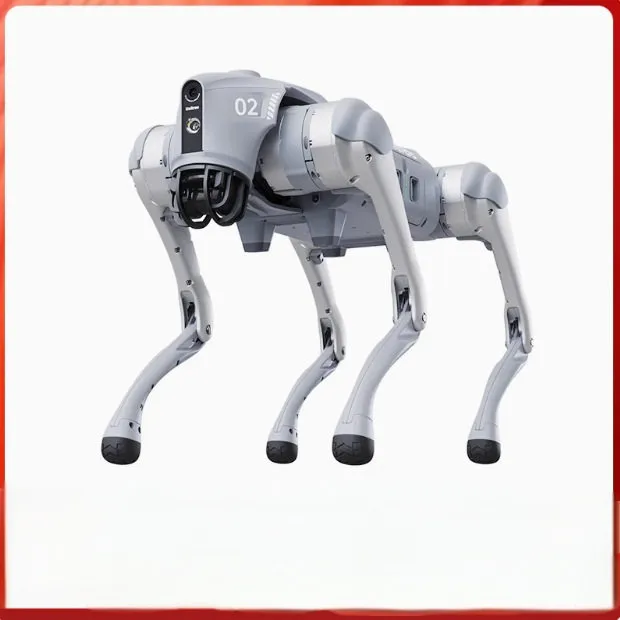
Searching for "Unitree Go2 vs Xiaomi CyberDog" means you have moved past the novelty and are actually deciding which robot dog to buy. Good — these are the two machines most people worldwide are choosing between, and they come from opposite philosophies.
Unitree's Go2 (from ~US$1,600) is the world's best-selling robot dog — a performance machine built for engineering, research and serious autonomy work. Xiaomi's CyberDog 2 (~US$1,785, ¥12,999) is an ecosystem product — a consumer-grade quadruped riding on Xiaomi's AIoT platform and an aggressively open-source SDK. Same species, different jobs.
| Spec | Unitree Go2 | Xiaomi CyberDog 2 |
|---|---|---|
| Price | From ~US$1,600 | ~US$1,785 (¥12,999) |
| Height / weight | ~40 cm / ~15 kg | 48.1 cm / ~8.9 kg |
| Degrees of freedom | 12 | 12 (CyberGear joints) |
| AI compute | 8-core CPU + 4D LiDAR L1 | 21 TOPS NX chip + 2 co-processors |
| Sensors | 4D LiDAR L1 (360°×90°, 0.05 m), wide-angle camera, IMU | 19 sensors: RealSense depth, fisheye, ToF, laser, ultrasonic, 4 mics, touch |
| Battery / runtime | 8,000 mAh 28.8 V (opt. 15,000), ~2-4 h | ~90 min |
| Top speed | ~3.5-3.7 m/s | ~1.6 m/s |
| Key trick | Front flips, handstand walking, Rage Mode | Backflips, 30,000+ simulated-dog training |
| Strategy | Performance + volume + autonomy | Ecosystem + open source + consumer reach |
The Go2 is the machine that turned quadruped robots from lab curiosities into a global consumer-industrial product. Its self-developed 4D LiDAR L1 sees 360°×90° down to 0.05 m, the 8,000 mAh 28.8 V pack runs 2-4 hours with hot-swap options, and the EDU model adds foot-end force sensing and a 12 kg payload. It flips, walks on its front legs, and hits ~3.5-3.7 m/s. At ~US$1,600, it undercuts every serious alternative and ships by the tens of thousands.
The CyberDog 2 is Xiaomi's bet that quadrupeds win through software and ecosystem, not raw specs. It packs a 21 TOPS NX chip with two co-processors, 19 sensors including RealSense depth and touch, and a deliberately open-source platform with a huge developer community. Xiaomi trains each behavior on over 30,000 simulated dogs. It is lighter (8.9 kg), cheaper-feeling and less agile than the Go2 — but for tinkerers and students, the open ecosystem is the whole point.
This is not really a fair fight, and Xiaomi knows it. Unitree builds a working robot; Xiaomi builds a learning platform shaped like a robot. If you want the best robot dog, buy the Go2. If you want the best way to learn how robot dogs work, the CyberDog 2's open ecosystem is genuinely valuable. Most buyers who compare these two end up on the Go2 — that is why it ships in the numbers it does.
Hangzhou's cost-engineering humanoid and quadruped maker.
Every Go2 spec — dimensions, joints, LiDAR, battery, price.
The Go2 in the product database, with the full model matrix.
How China's other quadruped-adjacent robotics conquered homes.
Profiles, product pages and supplier analysis for China's robotics ecosystem.