Unitree Robotics — Profile
Hangzhou's cost-engineering humanoid and quadruped maker.
The Go2 is the world's best-selling robot dog — and it starts at around US$1,600. Here is every spec that matters and what the money actually buys.
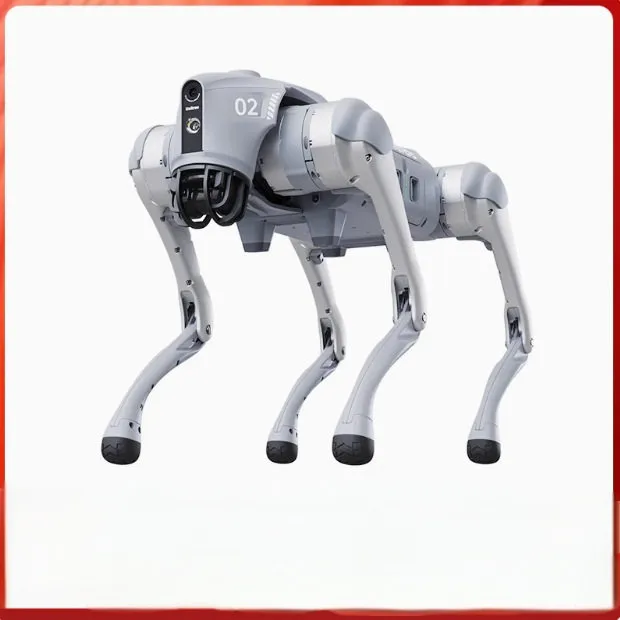
Searching for "Unitree Go2 specs" usually means one thing: you want to know if a ~US$1,600 robot dog is genuinely useful or just a toy. It is the same question everyone asks about the Go2, and the answer is in the details. This is the full breakdown.
The Go2 launched in 2023 and immediately reset the quadruped market. At a starting price of about US$1,600 (¥9,997 in China), it undercut every serious competitor and became the best-selling robot dog in the world. The Go2 Pro, with a controller and better features, runs around US$2,800 — still dramatically cheaper than the industrial-grade units of the previous generation.
| Size (standing) | 70 × 31 × 40 cm |
|---|---|
| Weight (with battery) | ~15 kg |
| Degrees of freedom | 12 |
| Max joint torque | ~45 N·m (Pro / X / EDU) |
| Max running speed | Up to ~5 m/s |
| Payload | 7–8 kg standard (up to 12 kg on EDU) |
| Battery | 8,000 mAh @ 28.8 V; ~2–4 h runtime (15,000 mAh long-range optional) |
| LIDAR | Unitree 4D LIDAR L2 — 360° × 96°, min detection 0.05 m |
| Compute | 8-core high-performance CPU |
| Connectivity | Wi-Fi 6, Bluetooth, 4G |
| Price | From ~US$1,600 (Go2 Pro ~US$2,800) |
The headline hardware is the self-developed 4D LIDAR L2 — a hemispherical, ultra-wide-angle sensor covering 360° × 96° with a minimum detection distance of just 0.05 m. That combination lets the Go2 map tight indoor spaces and rugged outdoor terrain without blind spots, and it is what enables the "all-terrain" autonomy the Go2 is known for. On top of the LIDAR sit HD wide-angle cameras and an 8-core CPU running the navigation and AI stack.
The Go2 family splits roughly into Go2 Air (entry), Go2 Pro (best-seller, ~45 N·m joints, better payload), Go2 EDU (education/research, 8-core CPU, max payload ~12 kg) and Go2-W (wheeled version on 7-inch pneumatic tyres for flat-floor efficiency). Prices stretch from about US$1,600 to over US$20,000 for the full EDU and industrial configs.
The Go2 is not a research-grade platform and not a toy — it sits exactly in the sweet spot China excels at: 80% of the capability at 20% of the price, with a software ecosystem that keeps improving over the air. For developers, educators and integrators it is the default entry into legged robotics; for heavy industrial work you step up to the B2 or industrial quadruped lines.
Hangzhou's cost-engineering humanoid and quadruped maker.
The $16k humanoid that changed the game — every spec.
How Unitree's compact humanoid stacks up against the full-size flagship.
Hangzhou's other quadruped maker, from rescue to industry.
Unitree, Deep Robotics, Yobotics and 100+ more Chinese robotics profiles in the database.